The Case for Read-Only RootFS
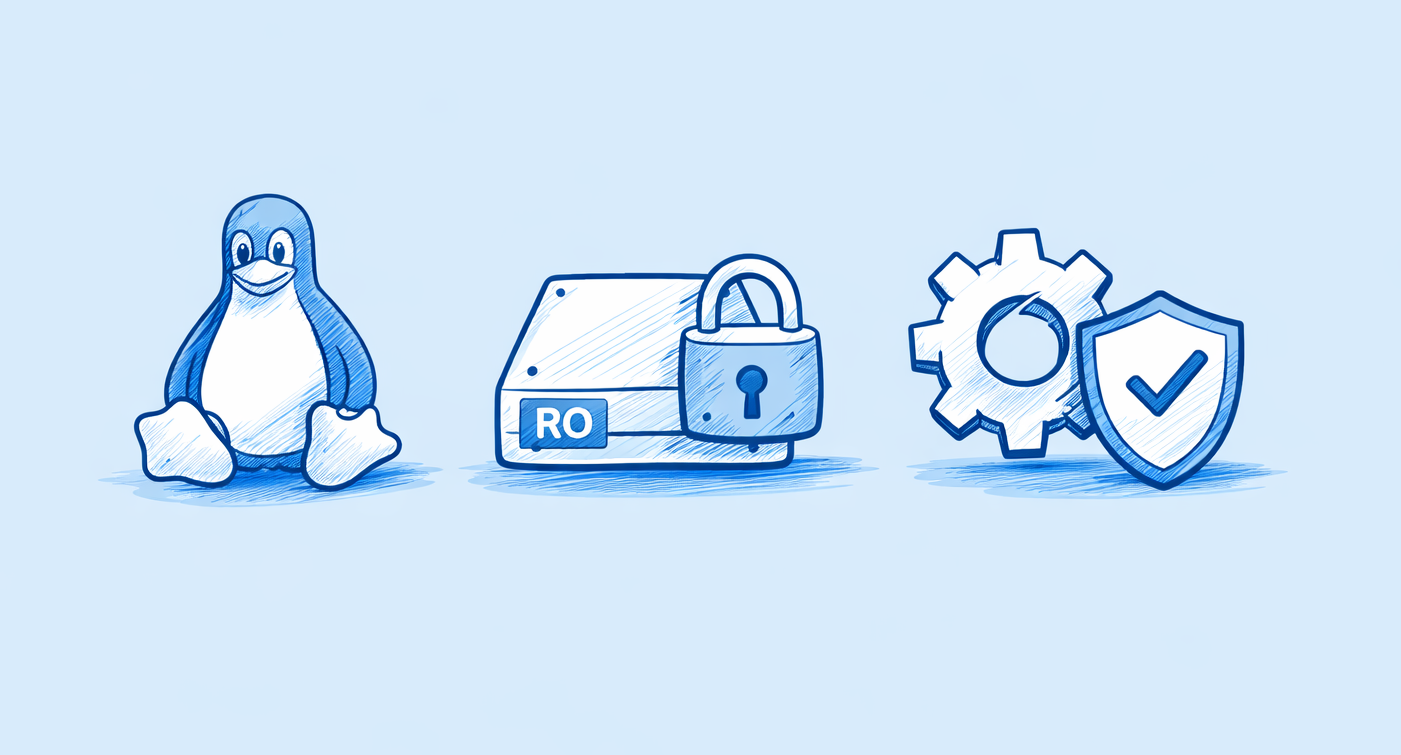
Most embedded failures aren’t caused by “bad” code at launch. They’re caused by software drift after launch.
A power outage corrupts a config. A log fills a disk at 2 AM. An OTA update half-writes, bricking 10,000 devices. There is one high-leverage decision that kills these failure modes: Make your root filesystem read-only.
Entropy vs. Reliability
Every writable filesystem is a surface area for entropy. The more things that can change, the more things will change - usually in ways you didn’t plan for.
| Writable | Read-Only | |
|---|---|---|
| State | Non-deterministic. Every device is unique. | Deterministic. Device #1 == Device #5,000. |
| Debugging | Impossible to reproduce local “drift.” | If it works on your desk, it works in the field. |
| Updates | Risky “diffs” on live files. | Atomic A/B flips. 100% rollback guarantee. |
The “Calm Team” Protocol: Ending the Conflict
The biggest source of friction in engineering teams is the “quick fix” or the “special case”.
When a root filesystem is read-only, you eliminate political conflicts of interest. If a developer wants to “just install a quick package” or “manually tweak a device config” to support a one-off request, the answer isn’t a managerial “No” - it’s an architectural “Not Possible”.
- Deterministic State: The device is an appliance, not a server.
- Zero Drift: Because the state is locked, there is no “it works on my machine but not theirs” debate.
- Reduced Cognitive Load: Your team stops worrying about how a device got into a weird state and starts focusing on the image itself.
This constraint is a feature. It forces the team to solve problems in the build system rather than patching live devices.
The Security & Ops Lever
Persistence is Hard: If an attacker gains access, they can’t modify binaries or install backdoors that survive a reboot. Every power cycle is a factory reset of the system core.
Operational Sanity: Support becomes binary. You aren’t managing 10,000 unique devices; you’re managing three known firmware versions.
How to Execute
If you’re using Yocto, it’s a single line in your image recipe:
IMAGE_FEATURES += "read-only-rootfs"The Clean Partition Layout
To make this work, you must separate Code from State:
- Root (Read-Only): The OS and app binaries. Compressed and immutable.
- Data (Writable): A small, dedicated partition for user settings and persistent logs.
- Volatile (RAM): For
/tmpand/var/run. Wiped on every reboot.
The Bottom Line
Read-only root isn’t a “technical trick” - it’s a philosophy of immutability. It trades a small amount of dev-time flexibility for massive gains in fleet reliability and team peace.
Spend three days handling your writable paths now, or spend three years chasing 2 AM filesystem corruption bugs later. Choose the calm team.